Archery Master: Bow and Arrow
- 4.4
- Rating
- 5.00M
- Installs
- Free
- Price

 Analysis by App-foxy
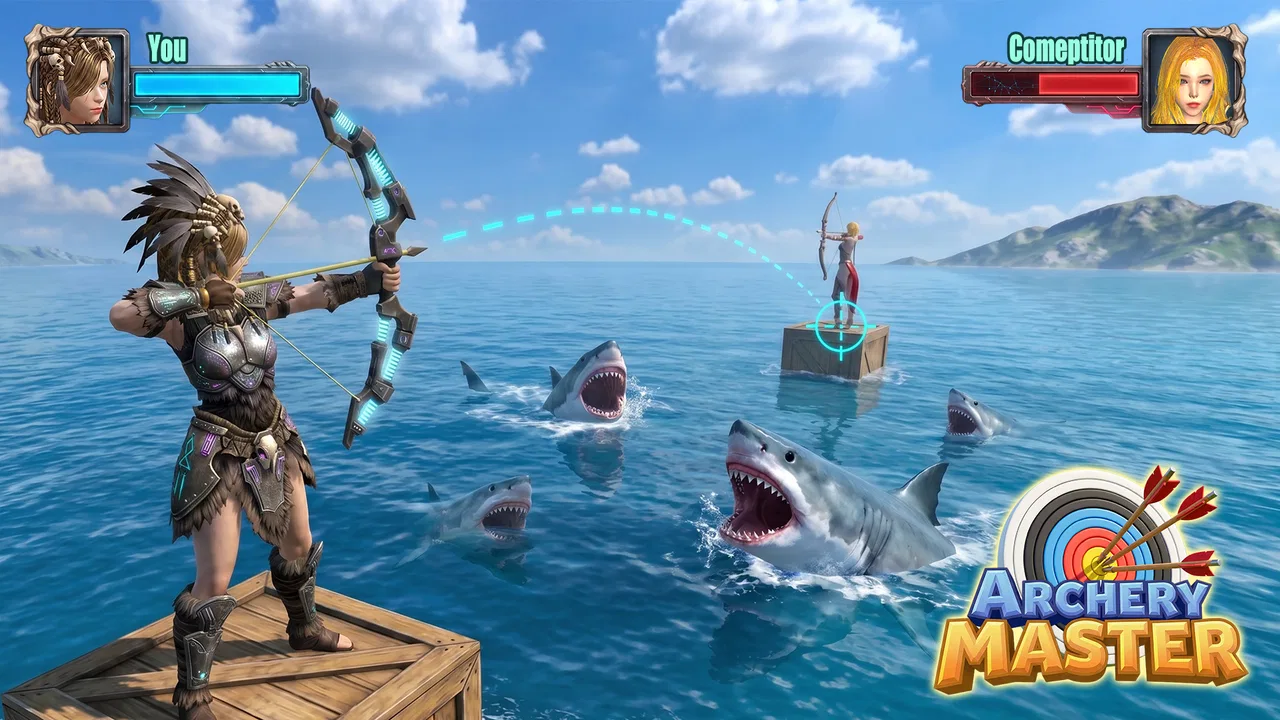
I spent time with Archery Master: Bow and Arrow as a quick competitive sports game, and its appeal became clear almost immediately: each round asks me to solve a small aiming problem, then live with the result. The focus is not on managing a large team, building a career, or learning a complicated rulebook. It is about stepping into a one-on-one archery duel, reading the shot, and trying to make the next arrow better than the last.
That simplicity is both the game’s strongest quality and its main limitation. I can understand the basic objective without a tutorial-heavy introduction, but the experience also depends heavily on whether I enjoy repeating a precise action while gradually improving my judgment. When the wind and angle work against me, a good shot feels earned. When I am not in the mood for careful aiming, the same structure can feel narrow.
How the first matches establish a clear goal
The opening experience works because the immediate goal is easy to grasp: win the duel by shooting more effectively than the opponent. I do not need to memorize a long list of controls before playing. Instead, I can concentrate on the relationship between the bow, the target, the angle of the shot, and the changing conditions around it.
You May Also Like

 Google Keep - Notes and lists
Google Keep’s Quiet Growth Shows the Appeal of Simpler Notes
As mobile work gets busier, Google Keep keeps winning a simple contest: capture a thought quickly, find it later, and get on with the day.

 Blood Strike: 2.5 Anniversary
Blood Strike’s Loadouts Turn Every Drop Into a Tactical Gamble
A close look at Blood Strike’s custom loadouts: how fast access to signature weapons reshapes its battle royale rhythm, rewards preparation, and narrows the gap between fights.

 Pandora - Music & Podcasts
Pandora’s Music Is Easy to Start, but Harder to Recover
Pandora’s strength is its low-effort path from a seed to a station. Its weak spot is how much confidence it asks you to place in connection, setup, and quiet recovery.

 8 Ball Pool
 Is Built on Rivalries, Rematches, and Routine
A close look at the rivalries, rematches, shared routines, and unanswered safety questions that turn a quick pool match into a persistent mobile community.

 Samsung Music
’s Quiet Strength Is Playing What You Already Own
Its reach comes less from spectacle than from dependable access to a personal library. That simplicity is both the app’s strongest retention engine and its ceiling.

 AccuWeather: Weather Radar
AccuWeather Review: A Quick, Clear Forecast for Everyday Decisions
For everyday plans, the best forecast is the one you can understand quickly. AccuWeather makes rain timing, radar, and local conditions easy to act on, with a few trade-offs.
More From Our News Desk



That makes the early matches useful as practice rather than just a formality. I quickly learn that pointing at the target is not enough. A shot that looks correct at first can drift when the wind is taken into account, and a rushed adjustment can be worse than making a smaller correction. The game encourages me to pause for a moment, inspect the situation, and commit.
I particularly like that the first goal is performance-based rather than purely decorative. Winning a duel gives me a direct reason to keep playing, while a miss gives me something specific to examine. Was my angle wrong? Did I overcorrect? Did I ignore the wind? That kind of immediate feedback is more satisfying than simply tapping through a sequence of menus.
For someone who wants a sports game that can be understood in a few minutes, this is a strong starting point. It also suits short sessions. I can play a match when I have a spare moment without needing to remember a complex storyline or maintain a large roster. The trade-off is that players looking for a broad simulation of archery may find the opening deliberately focused rather than comprehensive.
Why the aiming model matters more than fast reactions
The most important adjustment I made was to stop treating every shot as a reflex test. The better approach is to read the situation before touching the final aim. Wind changes the decision, and the angle can turn a seemingly safe attempt into a poor one. I found that careful observation usually helped more than trying to move quickly.
This creates a useful rhythm: assess, adjust, release, then learn from the result. It is a small loop, but it gives each arrow a purpose. Even when I lose, I usually know which decision deserves another look. That clarity is valuable because it prevents the game from feeling completely random.
A practical tip is to make one deliberate correction at a time. If I change the angle and compensate for the wind simultaneously without thinking through either choice, I lose track of what actually affected the shot. Smaller adjustments make the next attempt easier to understand. This is one of those habits that is not obvious from a short store description, but it noticeably improves the experience.
The controls also make the game approachable for players who are not familiar with archery games. I do not need specialist knowledge to begin, yet the interaction leaves room for judgment. The result is a middle ground between an arcade tap game and a detailed simulation. It is accessible at the surface, but precision still matters once the early confidence fades.
Progress signals that make another duel worthwhile
The game’s progression is most convincing when I treat improvement itself as a form of progress. A successful round demonstrates that I understood the conditions, while a close loss often reveals a mistake I can correct. That keeps the early part of the experience moving without requiring a large amount of explanation.
Unlocks and challenge are important to the longer-term rhythm, but I would not describe the experience as a deep role-playing progression system. The satisfaction comes from becoming more consistent and handling tougher situations with less hesitation. If I expect a long list of character builds or a detailed equipment economy, I may feel that the structure is lighter than expected.
What works well is the connection between progress and skill. I am not simply waiting for an automatic power increase to solve difficult matches. I have to improve my reading of wind, my control of angles, and my patience. That makes victories feel personal. The game gives me a reason to replay because I want to perform better, not only because a number on a profile has increased.
There is also a useful distinction between a lucky hit and a repeatable shot. A single excellent result can be exciting, but consistency is what makes the game feel mastered. I started judging my sessions by whether I made sensible decisions, even when the final result was not perfect. That mindset reduces frustration and makes the learning curve feel fairer.
For everyday play, I found a short routine helpful. I would begin with a few matches focused on observation rather than winning at any cost. After that, I would try to apply one adjustment, such as allowing more for the wind or avoiding a dramatic angle change. This turns a casual session into a small practice exercise and gives the progression a clearer shape.
Where the challenge begins to separate casual players
The difficulty becomes more meaningful once basic aiming is no longer enough. Early success can create the impression that the game will remain effortless, but stronger opposition and less forgiving situations demand more disciplined choices. I had to stop relying on the same visual instinct for every shot.
This is a reasonable curve for a competitive sports game. The controls remain understandable, while the decisions become more demanding. I do not need more buttons to feel challenged; I need better timing and a more accurate reading of the conditions. That is a good design choice for a game built around one-on-one duels.
Still, the curve may feel uneven for players who prefer constant forward momentum. A difficult match can expose a weakness very suddenly, especially if I have been making small errors without noticing them. The game is more enjoyable when I accept that a loss is part of the training process. Players who want every round to deliver an easy win may find the later pressure uncomfortable.
Another trade-off is that precision games can magnify control frustration. When I understand why an arrow missed, I am motivated to try again. When I feel that my adjustment was difficult to judge, the same failure is less satisfying. For that reason, I recommend playing with a steady hand and avoiding rushed inputs. The game rewards attention more than frantic movement.
How pacing and retention pressure affect the experience
The pacing is built around repeated duels rather than long matches with many phases. That helps the game remain approachable, especially on a phone. I can enter, make decisions, finish a contest, and stop without feeling that I abandoned a lengthy session. The compact structure is one of the reasons I can imagine returning during a commute break or while waiting for an appointment.
At the same time, repetition is unavoidable. The central action remains aiming, accounting for conditions, and trying to outperform the opponent. If that loop is satisfying to me, the repetition becomes practice. If I need frequent changes of activity, it can start to feel like the game is asking for the same kind of attention too often.
The retention pressure comes mainly from the desire to improve and overcome the next challenge. That is healthier for my enjoyment than chasing progress without understanding it, but it also means the game has limited appeal when I am tired of precision play. I would not choose it as my only mobile game if I wanted a broad selection of modes or a constantly changing set of activities.
In-app purchases range from $0.99 to $99.99 per item, so I would approach the optional spending carefully. The free entry point makes it easy to test the core loop before deciding whether the game deserves any money. My advice is to play long enough to learn whether the aiming and duel structure hold your attention; a purchase cannot fix a mismatch between your preferences and the basic gameplay.
The mature age rating of 17+ is also worth considering before installing it for a younger player. I would check the store presentation and device settings myself rather than assuming that a simple sports theme automatically makes it suitable for every age group.
Who will enjoy the loop, and who should skip it
I think the game is a good fit for players who like competitive sports challenges with a clear cause-and-effect relationship. It suits someone who enjoys taking a few seconds to plan a shot, learning from small mistakes, and replaying a contest until the result reflects better decisions. It is also a sensible choice for people who want a free game that can be played in compact sessions.
I would be more cautious recommending it to players who prefer management, team-building, or realistic season structures. This is not the right choice if the main attraction of a sports game is controlling a full squad, following a league table, or making strategic decisions outside the match itself. A broader sports simulation would serve those needs better.
It may also be a poor fit for anyone who dislikes losing because of fine margins. The game asks me to accept that a small aiming mistake can decide a duel. That tension is the point, but it can become irritating if I want a forgiving arcade experience where most attempts succeed.
Compared with a typical casual target-shooting game, this feels more thoughtful because wind and angles make the shot a problem to solve rather than a simple tap on a stationary target. Compared with a full archery simulator, it is easier to enter and less demanding in terms of rules and long-term management. Its position between those two alternatives is clear: approachable controls, but enough environmental judgment to reward practice.
Device fit, version, and practical expectations
Arcloom is the developer behind the game, and the current version is 1.8.8. It supports devices running Android 6.0 or later, which gives it a broad technical starting point for Android users. I would still consider the age and performance of a particular phone before expecting perfectly comfortable play, because precise aiming is less enjoyable when a device feels sluggish or the screen is difficult to use accurately.
The game is free to install, with over 5 million installs and a 4.4 average from around 159 thousand ratings. Those figures suggest that the format has reached a substantial audience, but they do not replace personal testing. The most important question is whether I enjoy the central aiming loop after the novelty of the first matches has passed.
The store also shows around 1.7 thousand written reviews, which gives prospective players a useful reminder that popularity and personal fit are different things. I would treat the game as an easy trial rather than a commitment. Since the entry price is free, the sensible workflow is to install it, play enough matches to encounter genuine challenge, and only then think about optional purchases.
One practical consideration is screen comfort. Because the game depends on judging small changes in direction and angle, I found it better suited to a quiet setting than to a situation where I was constantly distracted. It can work during a short break, but I would not expect the best results while walking, multitasking, or trying to play with one hand in an unstable position.
My verdict on the progression and staying power
Archery Master: Bow and Arrow succeeds when it keeps the focus on meaningful decisions. The early goals are clear, the progress signals come from both challenge and personal improvement, and the difficulty has a reasonable foundation because it asks for better judgment rather than a larger control scheme. I enjoyed the moments when a successful shot came from understanding the wind and angle instead of simply getting lucky.
Its limitations are equally clear. The loop is specialized, repetition is part of the design, and players seeking a full sports career or a wide range of activities should look elsewhere. The optional purchase range also means I would keep spending under control and evaluate the free experience first.
My strongest recommendation is for someone who likes short, focused duels and does not mind practicing the same skill until it becomes reliable. Start slowly, make one adjustment at a time, and judge progress by the quality of your decisions rather than by wins alone. The best reason to keep playing is the feeling that your next arrow is better because you understood the previous one.
With its free entry, mature age rating, and straightforward competitive premise, the game is easy to try but not universally suited. I would recommend it to patient sports-game fans who enjoy precision and controlled challenge. I would skip it in favor of a broader alternative if I wanted team management, varied events, or a more forgiving arcade pace.
FAQs for Archery Master: Bow and Arrow
01What is Archery Master: Bow and Arrow?
Archery Master: Bow and Arrow is a mobile archery game focused on aiming, timing, and precision. Players use touch controls to draw and release a virtual bow, then try to hit targets from different distances and angles. As you progress, the game generally introduces more challenging stages, moving targets, obstacles, and situations that require careful adjustment rather than simply tapping quickly.
02How do you play Archery Master: Bow and Arrow?
The main gameplay is based on controlling the bow with your finger. You usually drag or position the aiming direction, adjust for distance and movement, and release to fire the arrow. Accuracy is more important than speed, because a poorly timed shot can miss the target or reduce your score. New players should practice controlling the aim and learn how the arrow responds before attempting difficult challenges.
03Is Archery Master: Bow and Arrow free to download and play?
Archery Master: Bow and Arrow can generally be downloaded without an upfront purchase, allowing players to try the core experience for free. However, free mobile games may include advertising, optional in-app purchases, or extra content that requires payment. Before downloading, it is worth checking the current Google Play or App Store listing for pricing details, available purchases, and any restrictions that may vary by device or region.
04Does the game require an internet connection?
Whether Archery Master: Bow and Arrow works fully offline can depend on the version installed and the feature you are using. Basic stages may be playable without a constant connection, while advertisements, updates, online rewards, or other connected features may require internet access. If you plan to play while traveling or without mobile data, test the game in airplane mode after installation rather than assuming every mode will be available offline.
05Is Archery Master: Bow and Arrow suitable for children?
The game is generally easy to understand because its controls are based on aiming and shooting targets, but parents should still review the age rating and store description before installation. The main concerns are usually advertising, optional purchases, and the amount of screen time rather than realistic violence. Using parental controls and disabling unauthorized purchases is recommended if younger children will be playing on a shared Android or iOS device.
Pros
- Simple controls make aiming and shooting easy to learn.
- Short levels are convenient for quick gaming sessions.
- Increasing target distances provide a satisfying challenge.
- Bright visuals and clear targets keep gameplay easy to follow.
- Offline play makes it suitable for gaming without an internet connection.
Cons
- Gameplay can become repetitive after extended sessions.
- Some stages may feel more dependent on timing than skill.
- Limited variety in environments can reduce long-term appeal.
- Ads may interrupt the experience
- especially between rounds.
- Progression may feel slow without optional purchases or rewards.

Archery Master: Bow and Arrow
Gallery